Bi-Directional KV Transfer for Multi-Turn Agentic Workloads in vLLM
Multi-turn agentic workloads (or multi-turn conversations) are sequential dialogue exchanges between users and large language model (LLM) systems that maintain contextual coherence across interaction cycles. Implementing them requires persistent conversation-history management, where each subsequent user query is concatenated with the relevant historical context: system prompts, prior user queries, and model-generated responses.
In non-disaggregated deployments, the LLM inference server keeps sessions resident and reuses their KV cache across turns. Prefill-decode (P-D) disaggregated architectures, however, present a fundamental challenge on two fronts. First, the KV cache for model-generated responses from previous turns resides exclusively on the decode nodes and is inaccessible to the prefill nodes, so the current architecture forces prefill nodes to recompute KV projections for all response tokens on every turn, resulting in a substantial waste of AI-accelerator compute. Second, the decode node maintains the session state while the prefill nodes do not, which raises the probability of cache eviction for active sessions on the prefill nodes. On a cache miss, the prefill node must then recompute KV projections for the entire conversational context (system prompts, historical user queries, and prior model responses).
In this post we cover how bi-directional KV cache transfer between prefill and decode nodes optimizes KV cache utilization in P-D disaggregated deployments and cuts redundant prefill recomputation on multi-turn conversations, reducing time to first token by up to ~3x on long multi-turn prompts (see the Performance data section). We built the feature on AWS Trainium instance clusters with AWS Elastic Fabric Adapter (EFA, the low latency RDMA network protocol used across all servers in AWS) and upstreamed it to vLLM as an accelerator-agnostic feature. The results here are from an AWS p5en (GPU) cluster with EFA, showing the gains carry over to GPUs.
The feature is implemented in vllm/distributed/kv_transfer/kv_connector/v1/nixl/ and interoperates with vLLM’s hybrid KV cache manager for sliding-window models. It does not modify the existing standard P->D transfer path. These are purely additive extensions that activate only when bi-directional KV transfer is enabled and the multi-turn reusable token count exceeds the user-set threshold. Available with vllm>=v0.21.0.
Bi-directional KV transfer
Bi-directional KV transfer is a mechanism that allows a decode instance to return previously computed KV to a prefill instance on subsequent turns of a conversation, avoiding recomputation of shared context on the prefill node, governed by a cost-based recompute threshold. This mitigates both computational-redundancy scenarios described earlier: nodes load KV cache from each other, which removes unnecessary recomputation. Realizing this requires the KV to survive past the turn that produced it and to travel in the reverse direction, coordinated by a KV-cache-aware router.
NIXL KV connector enhancement for remote block handling
We extend the NIXL (NVIDIA Inference Xfer Library) KV connector to let prefill nodes consume remote KV blocks, similar to how decode nodes already consume the prefill node’s shared KV blocks. This is not a trivial change, because the two node types are architecturally different: prefill nodes compute KV representations for new prompt tokens and can provide complete prompt KV blocks. Decode nodes lack the capability (or efficiency) to generate complete KV representations and can only serve previously cached KV blocks. As a result, prefill and decode nodes still carry their own roles and logic for computing the metadata of remote and local KV blocks. The actual KV transfer mechanism (a NIXL READ), however, is common to both the P->D and D->P directions.
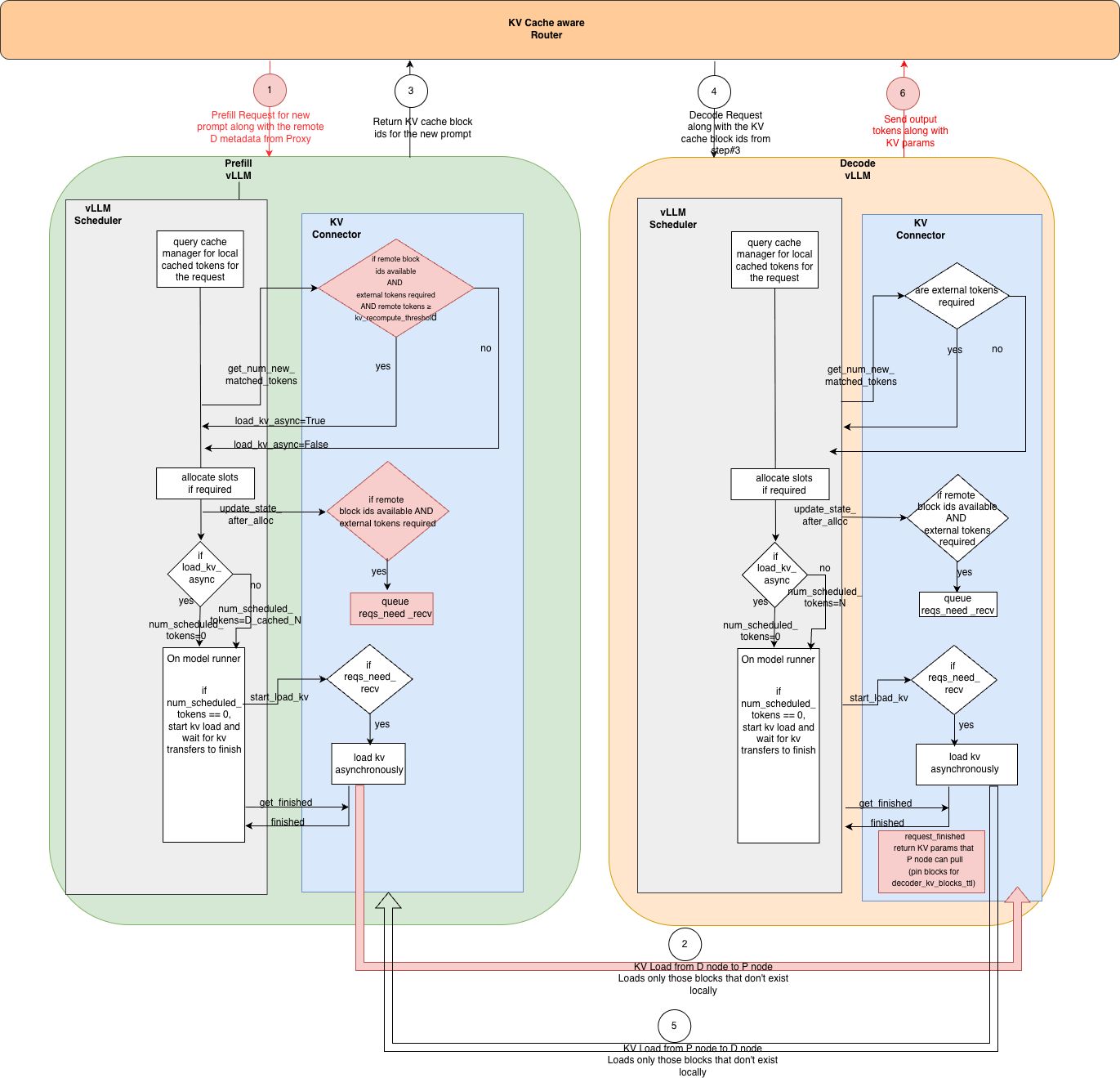
KV cache aware router
The KV-cache-aware router in a vLLM deployment is a lightweight, stateful component between the client, the prefill (P) node, and the decode (D) node. It maintains an in-memory cache of kv_transfer_params keyed by conversation_id, which the client carries across turns of the same conversation session. On the first turn of a conversation (cache miss), the router sends the request to P with empty remote_block_ids, so P computes the full KV cache from scratch. On subsequent turns (cache hit), the router looks up the cached block IDs from the previous turn and passes them to P. P then pulls the existing KV cache directly from D through remote direct memory access (RDMA) and computes only the new tokens. This keeps the router’s role minimal: it never queries D for cache state, never holds KV data itself, and adds no extra hops to the critical path. The only state it tracks is a mapping from conversation_id to D’s block metadata, which it captures for free from the token stream already flowing through it.
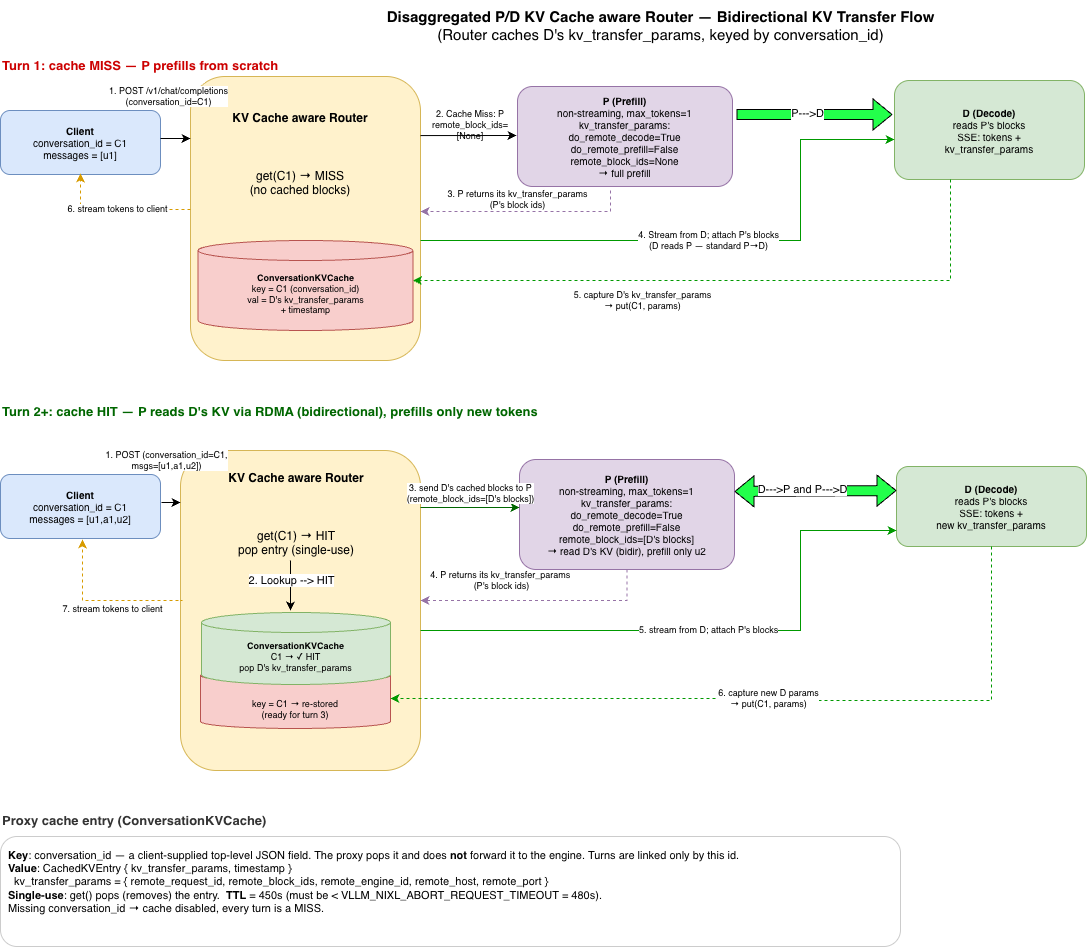
Block retention TTL
Normally a decode instance frees a request’s blocks as soon as generation finishes. Under bi-directional mode it holds them for a configurable lifetime (decoder_kv_blocks_ttl, default 480 seconds) and publishes their location and expiry, so the conversation’s KV, both prompt prefix and generated response, stays available for the next turn. That turn’s prefill instance reads the blocks back from the decode instance and reuses them instead of recomputing the grown context. A turn that arrives inside the window reuses the KV; one that arrives later falls back to normal prefill.
The window is fixed rather than renewable, which is the main tradeoff today: if the next turn never comes, whether the client moves on or its prefill instance fails, the blocks stay pinned until it expires. Prefill-side blocks avoid this with a much shorter heartbeat-renewed lease (kv_lease_duration, default 30 seconds), but the next turn’s timing is client-driven, so there is no peer to renew against. For now, tune decoder_kv_blocks_ttl down to the gap you actually expect between turns. A natural next improvement is to extend the heartbeat-renewed lease to the decode side, so a decode instance reclaims blocks as soon as a conversation goes idle rather than at the end of a fixed timer.
Cost-based recompute threshold
Reuse is not always the cheaper option. The reverse transfer incurs interconnect and coordination overhead, so for a short reusable prefix it can cost less to recompute the tokens than to move their KV across instances. The connector makes this trade-off explicit through a recompute threshold (kv_recompute_threshold, default 64 tokens). When the number of reusable tokens held on the decode instance is below the threshold, the prefill instance recomputes locally. When it is above, the prefill node pulls the KV from the decode instance. This keeps the transfer path active only when it is expected to pay off, and lets deployments tune the crossover point to their interconnect bandwidth and model compute cost.
Performance data
Across both Qwen3-32B and GLM5.2, turning on bi-directional KV transfer sharply reduces prefill cost on multi-turn conversations, and the benefit grows with prompt length. With the feature OFF, the prefill instance recomputes the entire grown context each turn, so TTFT rises steeply: Qwen3-32B climbs from 158 ms at 2k to 778 ms at 24k, and GLM5.2 from 500 ms at 2k to 2,334 ms at 20k. With it ON, the decode instance’s retained KV is reused instead of recomputed, keeping TTFT far flatter: Qwen3-32B rises only from 122 ms to 460 ms over the same range (about a 1.7x reduction at the longest prompt), while GLM5.2 rises from 358 ms to 702 ms and runs up to ~3x below the recompute path at long prompts.
The prefill-duration breakdown explains why. Bi-directional transfer adds a small KV-transfer cost (about 30 ms at 2k rising to ~130 ms for Qwen3-32B; about 29 ms to 110 ms for GLM5.2), but the prefill compute it removes far outweighs that cost. As a result, the total prefill duration with transfer ON (Qwen3-32B 128 ms to 414 ms; GLM5.2 316 ms to 541 ms) stays well below the recompute-only path (Qwen3-32B 153 ms to 744 ms; GLM5.2 500 ms to 2,331 ms). The larger GLM5.2 model shows a bigger absolute and relative gap, since its higher per-token recompute cost makes KV reuse pay off even more as models and contexts scale.
All runs use 10-turn conversations with 150-token user turns and 300-token responses, and prefix caching disabled on the prefill node to emulate cache-evicted prefill nodes.
Qwen3-32B
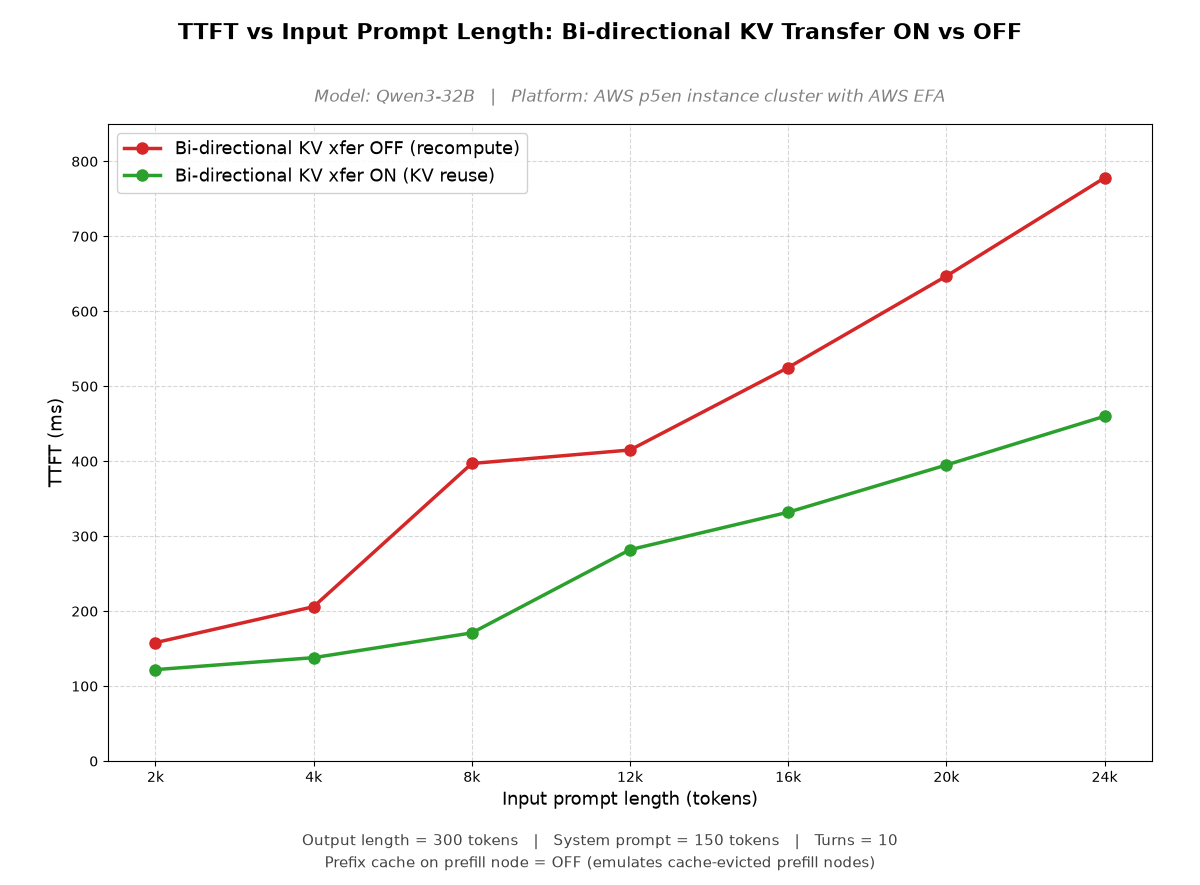
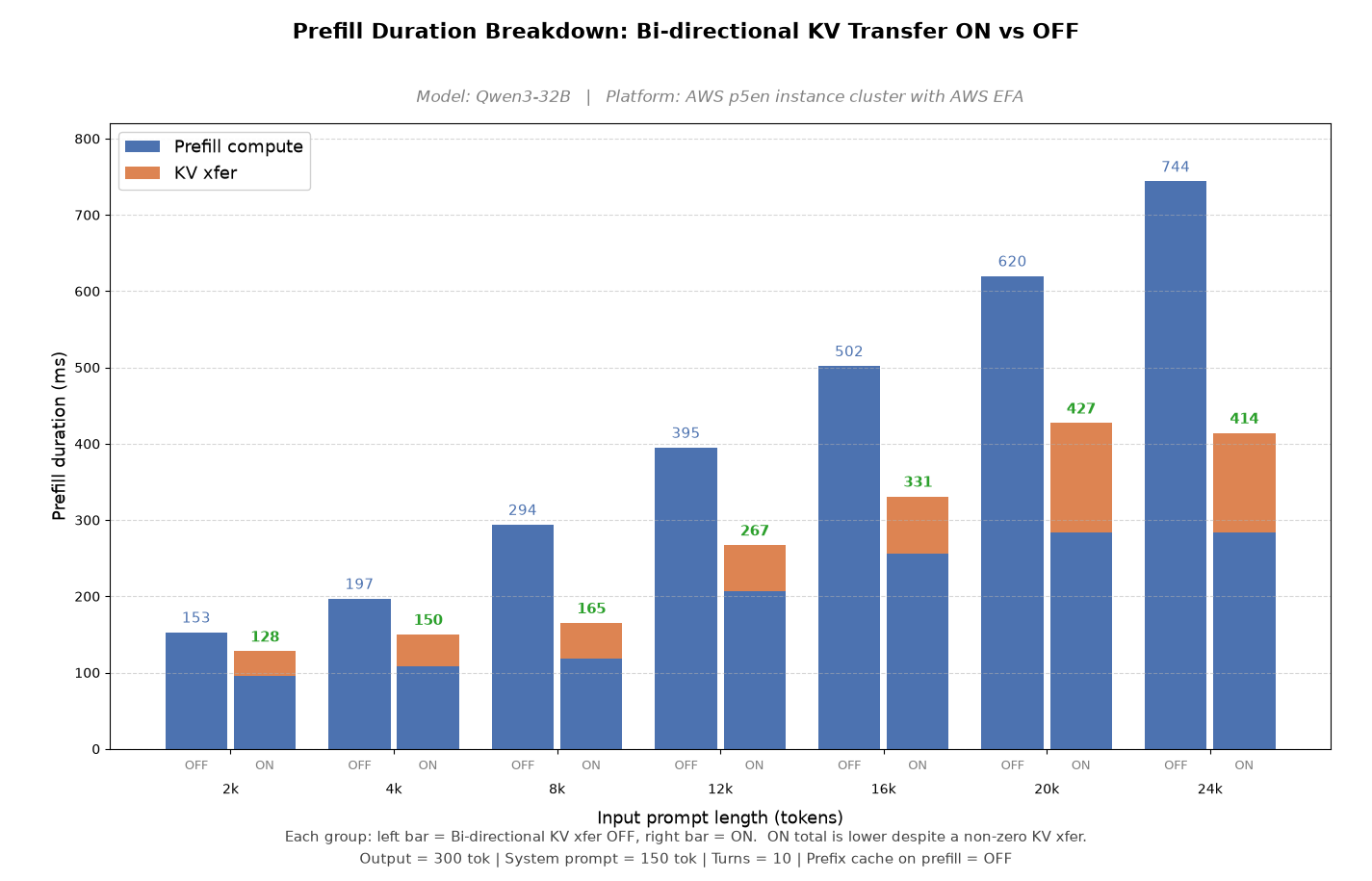
Together the charts show TTFT staying nearly flat with the feature ON while the OFF path climbs steeply as context grows, because the small KV-transfer cost is far outweighed by the recompute it removes.
GLM5.2
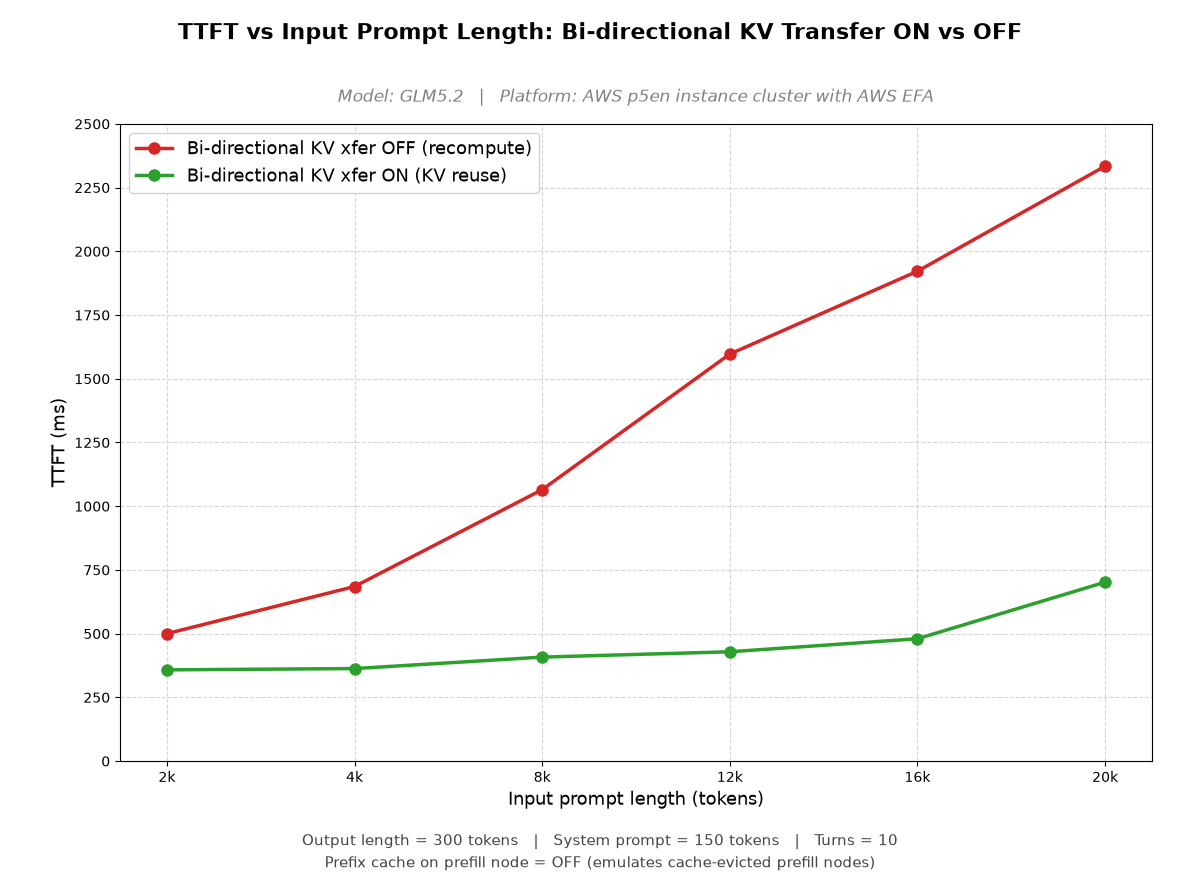
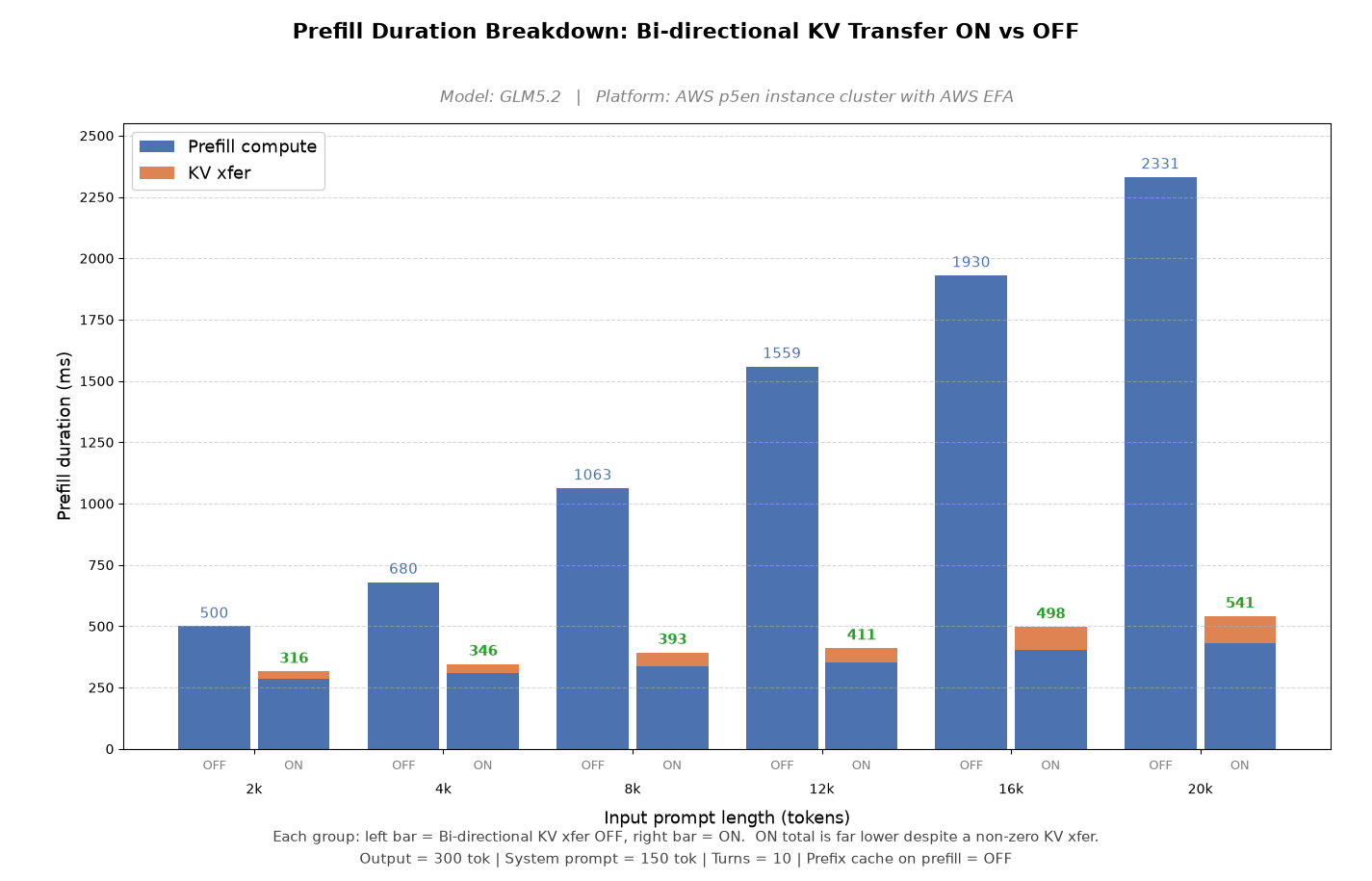
GLM5.2 shows a much larger gap than Qwen3-32B — up to about 3x lower TTFT at long prompts — because its higher per-token recompute cost makes KV reuse pay off even more as context length grows.
Conclusion
Bi-directional KV cache transfer removes redundant prefill recomputation in P-D disaggregated deployments by letting prefill nodes reclaim previously computed KV from decode nodes on later turns, governed by a block-retention window and a cost-based recompute threshold. On multi-turn workloads this keeps TTFT under SLA limits for a longer context length compared to without the feature. In our multi-turn benchmarks, this cut time to first token by up to about 1.7x for Qwen3-32B and about 3x for GLM5.2 at long prompts.
Appendix: Reproducing our results
The topology is two AWS p5en instances (prefill on :8100, decode on :8200) with EFA enabled, plus a third small node running the proxy and the benchmark client on :8000.
Three scripts ship with this post: serve_pd_multiturn.sh launches either leg with the feature on or off, run_multiturn_sweep.sh drives the prompt-length sweep, and cleanup.sh tears the deployment down.
1. Provision the nodes
Install the EFA userspace stack on both GPU nodes:
curl -O https://efa-installer.amazonaws.com/aws-efa-installer-latest.tar.gz
tar -xf aws-efa-installer-latest.tar.gz && cd aws-efa-installer
sudo ./efa_installer.sh -y
fi_info -p efa            # verify the EFA provider is present on both GPU nodes
2. Install vLLM and NIXL on both GPU nodes
python3 -m venv ~/venv-pd && source ~/venv-pd/bin/activate
pip install --upgrade pip && pip install vllm==0.29.0 nixl==1.4.1
Apply vLLM PR #40186 once on both nodes. It attaches kv_transfer_params to streaming responses, which is what the multi-turn proxy needs to link turns: the proxy always queries the decode node with stream=True, so without this patch the decode node never returns the block metadata and every turn lands as a cache miss.
SITE=$(python -c 'import site; print(site.getsitepackages()[0])')
curl -sL https://github.com/vllm-project/vllm/pull/40186.diff -o /tmp/40186.diff
patch -p1 -d "$SITE" --fuzz=3 < /tmp/40186.diff
3. Download the model
export HF_HOME=/fsx/huggingface        # a large shared volume
hf download Qwen/Qwen3-32B
4. Launch the P/D pair
Run serve_pd_multiturn.sh once per GPU node. BIDIR is the only thing that changes between the two legs of the A/B, and it must match on both nodes:
# on the prefill node
P_IP=<P_IP> D_IP=<D_IP> ROLE=prefill BIDIR=false ./serve_pd_multiturn.sh
# on the decode node
P_IP=<P_IP> D_IP=<D_IP> ROLE=decode  BIDIR=false ./serve_pd_multiturn.sh
Which expands to, on the prefill side:
export FI_PROVIDER=efa
export VLLM_NIXL_SIDE_CHANNEL_HOST=<P_IP> VLLM_NIXL_SIDE_CHANNEL_PORT=5600
vllm serve Qwen/Qwen3-32B --served-model-name Qwen --dtype bfloat16 \
  --tensor-parallel-size 8 --max-model-len 32768 --max-num-seqs 8 \
  --no-enable-prefix-caching --port 8100 \
  --kv-transfer-config '{"kv_connector":"NixlConnector","kv_buffer_device":"cuda",
    "kv_role":"kv_producer","engine_id":"prefill-engine-001","kv_rank":0,
    "kv_parallel_size":2,"kv_connector_extra_config":{"backends":["LIBFABRIC"],
    "kv_recompute_threshold":64,"decoder_kv_blocks_ttl":480,
    "bidirectional_kv_xfer":false}}'
--no-enable-prefix-caching is set on the prefill node only — that is the cache-evicted scenario the benchmark emulates. Leave prefix caching enabled on the decode node. Wait for both /health endpoints to return 200.
5. Start the multi-turn proxy
python3 -m venv ~/venv-proxy && source ~/venv-proxy/bin/activate
pip install fastapi uvicorn httpx pandas numpy aiohttp transformers tqdm
sudo dnf install -y jq || sudo apt-get install -y jq
git clone --depth 1 --branch v0.29.0 https://github.com/vllm-project/vllm.git ~/vllm_src
export VLLM_SRC=~/vllm_src

python3 $VLLM_SRC/examples/disaggregated/disaggregated_serving/disagg_proxy_multiturn.py \
  --port 8000 --prefiller-host <P_IP> --prefiller-ports 8100 \
  --decoder-hosts <D_IP> --decoder-ports 8200 \
  2>&1 | tee ~/logs/proxy_$(date +%Y%m%d_%H%M%S).log
The proxy takes hosts and ports, not URLs. Reuse is driven by the client sending conversation_id, so there is no flag to enable it here.
6. Run the OFF leg, then the ON leg
VLLM_SRC=~/vllm_src LEG=off ./run_multiturn_sweep.sh
For the ON leg, stop both servers and the proxy, relaunch step 4 with BIDIR=true on each node, restart the proxy (its conversation cache is in-process), then:
VLLM_SRC=~/vllm_src LEG=on ./run_multiturn_sweep.sh
Repeat both legs for GLM5.2 with MODEL=zai-org/GLM-5-FP8 SERVED_NAME=GLM.
7. Collect the numbers
Three quantities, one per source:
- TTFT, from the benchmark’s per-request stats JSON written by
--stats-json-output. Each record carriesttft_msalongsideinput_num_tokensandconversation_id. This is the y-axis of the TTFT charts. - Prefill duration, from the proxy log, which reports the prefill leg of each request as
Prefill done in <N>ms. This is the total height of each bar in the prefill-duration breakdown. - KV transfer time and volume, from the prefill node’s log, which reports
KV Transfer metrics:lines with average and P90 transfer time, bytes per transfer, and throughput. This is the KV-xfer component of each ON bar.
NIXL telemetry is recorded by the side that initiates the transfer, so the D->P readback appears in the prefill node’s log while the ordinary P->D pull appears in the decode node’s log.
Average each quantity per prompt length, then plot: TTFT against prompt length as two lines (ON and OFF), and prefill duration as paired stacked bars per prompt length, with the ON bar split into prefill compute and KV transfer. The difference between the two views is the point — the transfer cost the bars expose is what the TTFT lines convert into a saving.
Troubleshooting
- The proxy always logs
cache MISSin an ON run — missing--send-conversation-id, PR #40186 not applied on both nodes, orBIDIR=falseleft on the decode node, in which case it returns nokv_transfer_paramsat all. Declining expired remote readon the prefill node — the decode node’s blocks lapsed before the next turn arrived. Raisedecoder_kv_blocks_ttl(default 480 s) and keep the proxy’s cache TTL below it.fi_info -p efais empty or falls back to sockets — the EFA provider is missing. Reinstallaws-efa-installerand confirm the instances were launched with EFA-enabled interfaces; without it NIXL either fails to initialize or quietly runs over TCP, which makes the transfer numbers meaningless.
Cleanup
./cleanup.sh proxy      # on the proxy / benchmark driver node
./cleanup.sh server     # on each GPU node
Then terminate the instances and verify none remain running.
Related resources
- AWS EFA
- Benchmark KV cache offloading with multi-turn conversations
- Bi-directional KV transfer pull request (#32553)
Acknowledgments
We thank Nicolò Lucchesi (Mistral), Mark McLoughlin (Red Hat), and the vLLM community for their continued support in reviewing and merging this feature.